
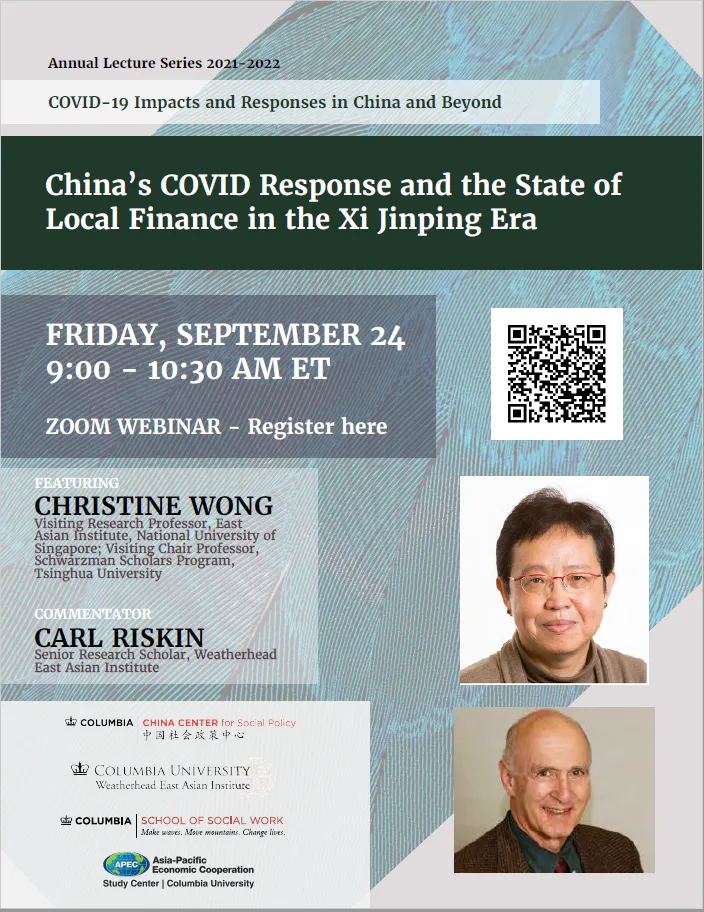
Annual Lecture: China’s COVID Response and the State of Local Finance in the Xi Jinping Era
About the Event:
In China’s decentralised fiscal system, since virtually all vital public services such as education, healthcare, and social welfare are provided by local governments, a well-functioning intergovernmental fiscal system is essential to ensure local governments have adequate incentives and resources to perform their role. Since 1978, China has overhauled its public finances to create a system able to finance government operations, support economic growth, and supply revenues for the government’s ambitious industrial policies and international initiatives. The COVID-19 pandemic has posed new challenges to China’s public finance that is likely to continue in the years to come.
This lecture provides an update on local finance through three decades of reform including those implemented since 2013, when a comprehensive package was announced, with promise of a realignment of central-local revenues and expenditures by 2020. The findings are that local fiscal status has deteriorated since 2015 due to a combination of slowing growth, tax cuts, and reform pressures. This has already led to a decline in social spending as a share of GDP, threatening to reverse some recent gains in improving public services and undermining other policy goals.
About the Speakers:
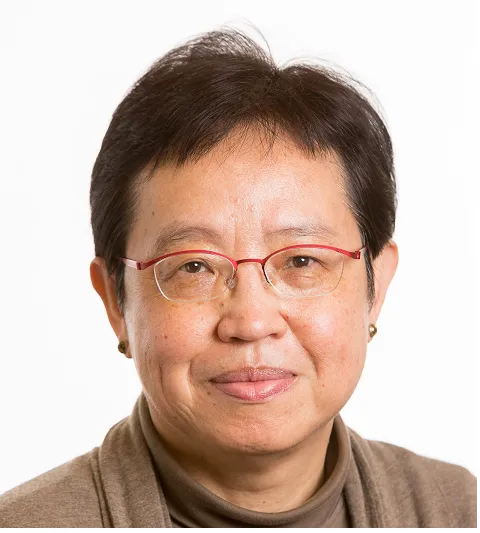
Presenter: Christine Wong, Visiting Research Professor, East Asian Institute, National University of Singapore; Visiting Chair Professor, Schwarzman Scholars Program, Tsinghua University
Professor Wong has been writing about China’s public finance for three decades, publishing widely on intergovernmental fiscal relations and their implications for governance, economic development, and welfare. Until March 2020, Christine Wong was Professor of Chinese Studies and Director of the Centre for Contemporary Chinese Studies at the University of Melbourne. From 2007 to 2013, she was Professor of Chinese Public Finance and Director of Chinese Studies at the University of Oxford, and the Henry M. Jackson Professor of International Studies at the University of Washington during 2000-2007. Professor Wong has held senior staff positions in the World Bank and the Asian Development Bank and worked with many other international agencies including the IMF, OECD, and UNDP. She is a member of the OECD Advisory Panel on Budgeting and Public Expenditures.

Commentator: Carl Riskin, Senior Research Scholar and Adjunct Professor of Economics, Weatherhead East Asian Institute; Distinguished Professor, CUNY Queens College
The core of Professor Riskin’s research has dealt with the complex and changing impact of economic development on people’s lives — what the United Nations calls “human development.” He is the author of China’s Political Economy: The Quest for Development since 1949 (Oxford University Press, 1987); Inequality and Poverty in China in the Age of Globalization (with A. R. Khan, Oxford University Press, 2001); and China’s Retreat from Equality (with R. Zhao and S. Li, M. E. Sharpe, 2001), as well as of numerous scholarly articles. He has also done much work on China and other parts of the world for the UNDP, including the production of the first two national Human Development Reports for China (Oxford University Press, 1997 and 1999). Professor Riskin’s recent research has dealt with the trends and driving forces of income distribution in China.
Moderator: Qin Gao, Professor and Director of China Center for Social Policy, Columbia School of Social Work
This event is part of the 2021-2022 lecture series on “COVID-19 Impacts and Responses in China and Beyond” and is co-sponsored by the Weatherhead East Asian Institute.